Advisor Suite | Research and Strategy
Unlocking greater business value for a pan-African financial institution by finding ways to make their tools more effective and usable
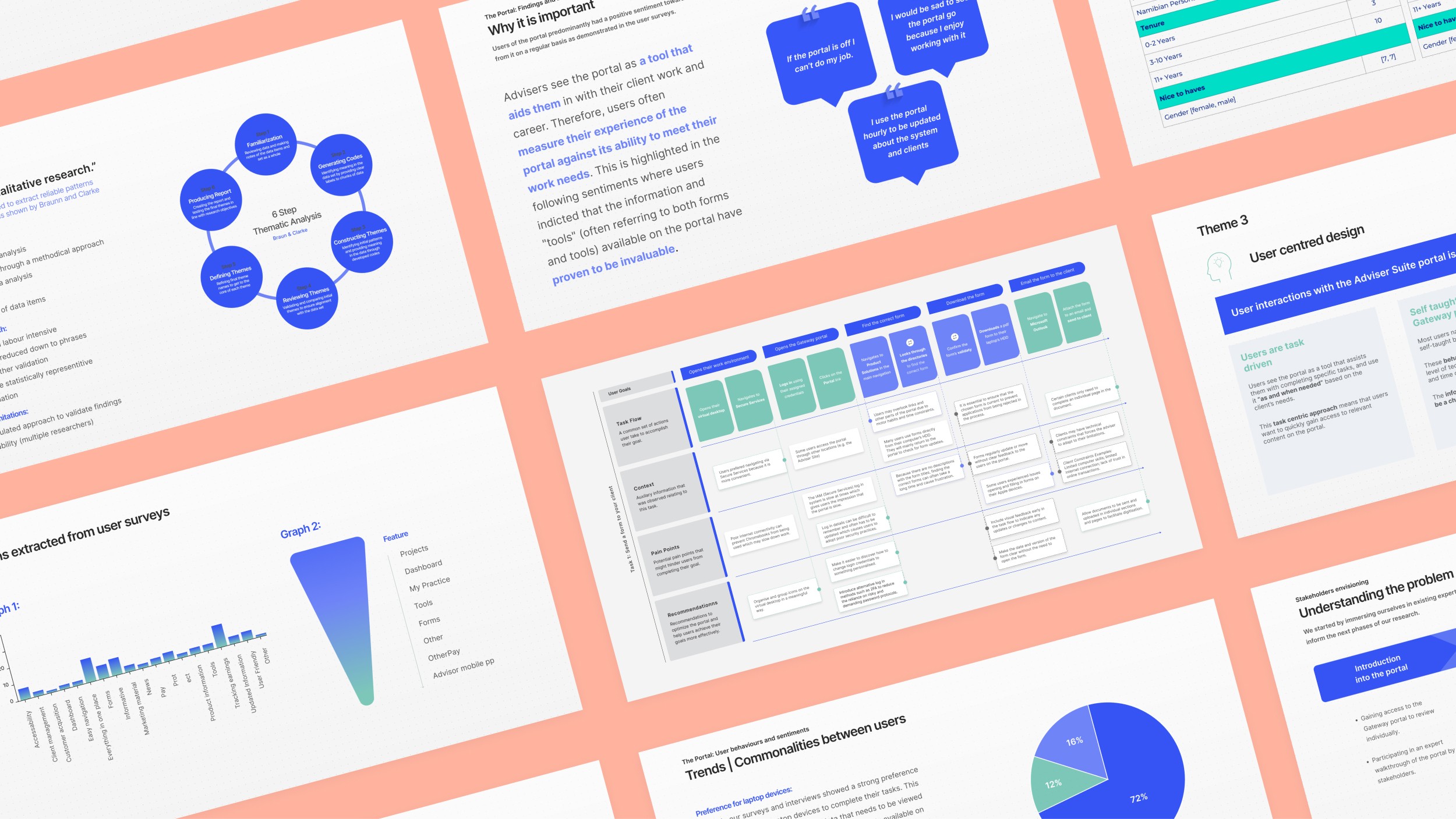
During this 8-week project, we were tasked with conducting a comprehensive investigation into an internal business tool. Our objective was to identify ways to enhance its usability and engagement, ultimately leading to a higher adoption rate of the client’s financial products.
About Advisor Suite
Advisor Suite is a business-critical platform used by internal and external financial advisors and their support staff across the continent to sell our clients’ financial products, like insurance.
Advisor Suite helps advisors service their customers by providing critical, time-sensitive content like contracts and product details; customer service tools like profile management and application portals; and business tools like messaging and notifications.
Our team
I was the UX researcher, collaborating with a principal researcher, in team one.
A second team dedicated to making rapid, high-level UI enhancements also joined the initial phase of this project.
The entire project, including all the research, was conducted remotely.
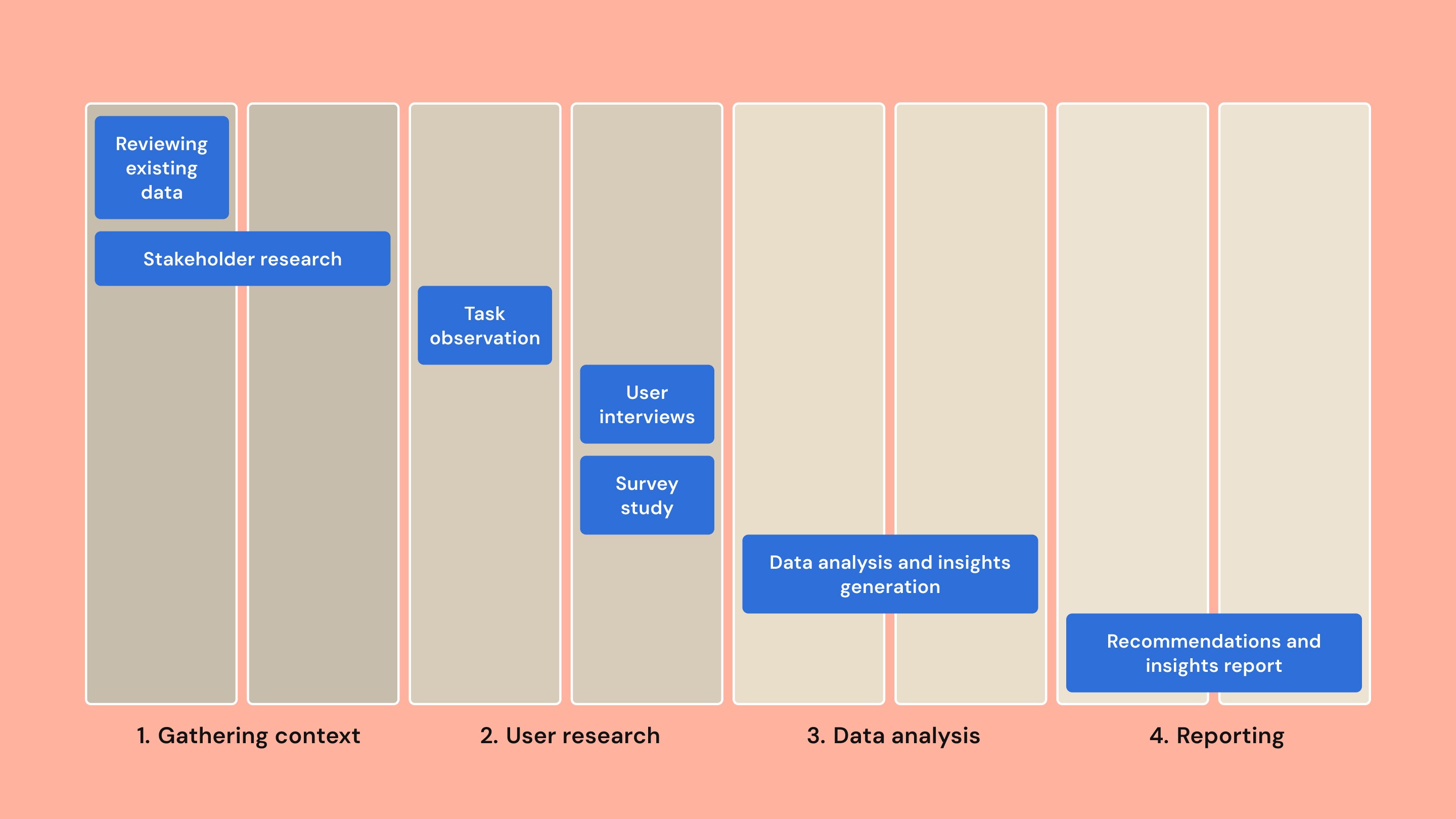
Timeline of the work my team did in our multi-phased approach.
Gathering context
After thoroughly analysing data and existing research, we interviewed nine stakeholders from diverse backgrounds to gain insights into their experiences, understand the organisational landscape, and ensure that our work aligns with the client’s objectives.
We presented the initial phase of our work to the stakeholders, accompanied by a report.
User research
We met with a total of 23 participants across 4 job titles in remote interviews. Our goal was to deeply understand the problem, the user’s context, and the way they do their tasks.
Data analysis
We analysed all the data using a reliable Thematic Analysis methodology to extract valuable, actionable insights, and continuously shared findings with the UI design team to help them make more effective design decisions.
Reporting
Our final deliverable was a 115-page insights report, which we played back to the client at the end. We also ensured a seamless handover of the knowledge to the next phase's team to implement our recommendations.
What we unlocked
Using the research and systems thinking, I helped take the Advisor Suite portal from a difficult-to-use media library to a focused value engine by giving UX recommendations that address specific pain points that cost time, money, and engagement to ensure that we meet the client’s business goals.
Increased engagement, the customer’s main sign of success, by making the portal more convenient to access and showing more helpful and engaging content on the home page.
Drastically reduced the “millions of [costly] support calls” by making important content easier to find.
Unlocked greater regional growth by identifying and addressing content gaps for Namibian advisers.
Reduced costly advisor rework and compliance risk by making form versions and dates more obvious—preventing wrongfully rejected client applications and delays.
Increased adoption of features with simple onboarding and clearer page layouts so that more users could confidently discover existing features.
Valuable insights about the advisors, which were circulated and utilized throughout the organisation.
Outcome
The final 115-page report served as a foundational asset for the subsequent phase of work and continues to inform various aspects of the client's organisation!
The report provided valuable insights into user behaviour, the Advisor Suite portal’s pain points and opportunities, task flow analysis and optimisation strategies, and strategic business and design recommendations.
Stakeholders were particularly appreciative of the clarity, depth, and alignment our research created in their organisation.
Appendix
🔎 What we learned from stakeholders
During our first phase, stakeholders and SMEs helped to guide us on where to start looking.
Our main goal should be to make it as easy as possible for financial advisors to serve their clients through the Advisor Suite portal, making it preferable for them to use our clients' products.
Stakeholders were not aware of what was happening in the Advisor suite landscape and didn’t know much about user needs and behaviours.
There weren’t clear processes for the Advisor Suite portal, which caused confusion and errors as people resorted to doing things on their own.
👥 User groups
Primary Users: The portal is primarily aimed at PFA, DFA, AFD, Independent Advisors, and their assistants.
Secondary Users: Support staff and Administrators who manage the portal and update content.
🔎 What we learned from users
From the research, we synthesised 4 key themes which guided the rest of the project.
Internal users only use what they are familiar with, and external users will only work with products and systems that are convenient to them.
- Efficiency is seen as a driving factor in becoming a successful advisor. This builds trust, gives advisors more time with their clients, and frees up much-needed time.
- Users’ work is complex and time-consuming. Therefore, simplifying processes and systems is vital to achieving a better user experience.
- Users are task-driven, and their interactions with the Adviser Suite portal are shaped by task-centric and self-taught behaviours.